
manhattan wms course
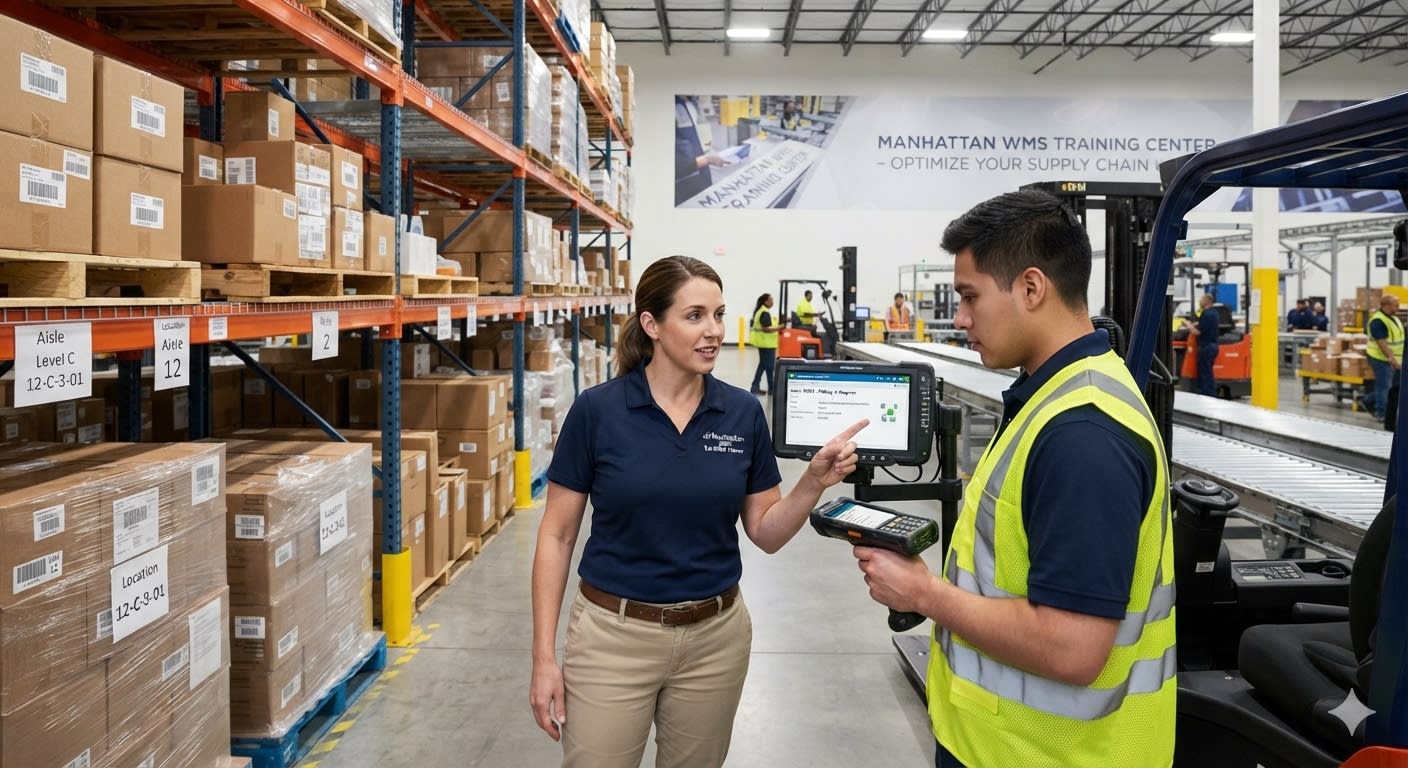
Manhattan WMS Training – Online Course, Implementation and Professional Learning
Build practical knowledge of warehouse management systems with Manhattan WMS Training designed for aspiring consultants, supply chain professionals, warehouse operations teams, business analysts, and IT professionals. Learn how warehouse processes connect with inventory visibility, order fulfillment, receiving, picking, packing, shipping, and system configuration through structured, role-oriented training.
Our Manhattan WMS training program is designed to help learners understand warehouse workflows, explore implementation concepts, and develop the functional knowledge required to work on real-world warehouse management projects. Whether you are starting your supply chain technology career, upgrading your existing skills, or arranging corporate training for your team, the learning path can be aligned with your experience and professional objectives.
Explore online training, instructor-led sessions, implementation-focused learning, and corporate training options for professionals across the USA, UAE, Saudi Arabia, UK, Australia, Singapore, Canada, Germany, the Netherlands, Qatar, and other international markets.
Ready to develop your Manhattan WMS skills? Contact our training team to discuss course coverage, upcoming batches, delivery formats, and a learning plan suited to your goals.
What Is Manhattan WMS Training?
Manhattan WMS training introduces learners to warehouse management concepts and the functional workflows supported by Manhattan Associates warehouse management solutions. A Warehouse
Management System (WMS) helps organizations coordinate warehouse activities, maintain inventory visibility, manage order processing, and improve operational control.
The Manhattan product ecosystem includes Manhattan Active® Warehouse Management and Manhattan SCALE™. The appropriate learning path depends on the product version, project requirements, existing experience, and the role you want to pursue.
A structured Manhattan WMS course can help you understand how warehouse transactions move through a distribution operation, how system rules influence execution, and how functional teams collaborate during implementation and support.
Training may cover conceptual demonstrations, guided exercises, business scenarios, process mapping, and troubleshooting discussions, depending on the selected course and available training environment.
Why Choose Our Manhattan WMS Course?
A useful WMS training program should connect system concepts with the operational problems businesses encounter every day. Our proposed learning approach emphasizes practical understanding, clear explanations, and role-based knowledge rather than memorizing terminology alone.
Structured learning: Progress from warehouse fundamentals to more advanced functional topics.
- Process-oriented training: Understand the relationship between inbound, inventory, outbound, and fulfillment workflows.
- - Implementation awareness: Explore requirements gathering, process mapping, configuration concepts, testing, and deployment activities.
- Career-focused guidance: Learn about the responsibilities of functional consultants, business analysts, super users, and support professionals.
- Flexible delivery: Discuss online, instructor-led, and customized corporate learning options.
- International accessibility: Explore remote training arrangements suitable for different time zones, subject to trainer availability.
Course duration, practical exercises, software access, fees, and trainer availability should be confirmed before enrollment.
Manhattan WMS Training Modules
The following curriculum is a proposed training outline. Exact modules and hands-on activities should be finalized according to the Manhattan product version and the training environment available.
Module 1: Introduction to Warehouse Management Systems
Understand the purpose of a WMS and its role in modern supply chains. Explore warehouse structures, distribution centers, inventory movement, order processing, and the relationship between warehouse operations and enterprise systems.
Module 2: Manhattan WMS Architecture and Navigation
Learn the relevant product terminology, user roles, navigation concepts, transaction flows, and system components. Where applicable, discuss
how the selected Manhattan solution interacts with enterprise resource planning (ERP), transportation management, warehouse automation, and other connected systems.
Module 3: Inbound Receiving and Putaway
Study purchase order or expected-receipt processes, receiving workflows, quantity verification, exception handling, and putaway concepts. Understand how products move from the receiving area into appropriate warehouse storage locations.
Module 4: Inventory Management and Control
Explore inventory visibility, stock status, location-level inventory, inventory adjustments, cycle counting, replenishment concepts, and discrepancy investigation. Learn why inventory accuracy matters for fulfillment, planning, and customer service.
Module 5: Outbound Processing and Order Fulfillment
Understand order allocation concepts, picking strategies, picking execution, packing, shipping confirmation, and shipment readiness. Discuss how warehouse teams manage order priorities and respond to operational exceptions.
Module 6: Warehouse Configuration and Business Rules
Explore the purpose of warehouse configuration, process rules, operational parameters, and master data. Depending on the product and
training access, examine how configuration choices can influence receiving, storage, picking, and shipping processes.
Module 7: Implementation, Testing, and Deployment
Learn the stages of a WMS implementation, including requirements gathering, process mapping, solution design, configuration planning, integration coordination, test scenarios, user acceptance testing (UAT), deployment preparation, and post-go-live support.
Module 8: Troubleshooting and Production Support
Understand how to investigate inventory discrepancies, blocked transactions, fulfillment exceptions, failed interfaces, and process bottlenecks. Learn structured problem analysis, documentation, escalation, and root-cause investigation.
Module 9: Advanced Warehouse Operations
Where supported by the selected product and course scope, explore replenishment optimization, labor management, slotting, wave or order streaming concepts, warehouse automation, and operational performance monitoring.
Module 10: Practical Scenarios and Career Preparation
Apply learned concepts to sample warehouse workflows, discuss functional interview questions, document business requirements, and review typical responsibilities across implementation and support projects.
Online Manhattan WMS Training
Online Manhattan WMS training is suitable for learners who want to develop warehouse technology skills without travelling to a physical classroom. Live virtual sessions can provide opportunities to interact with a trainer, ask questions, review process diagrams, and discuss practical business scenarios.
Depending on the selected program, online learning may include live classes, guided demonstrations, downloadable learning materials, assignments, revision sessions, and interview preparation.
This format may suit working professionals, career changers, international learners, and individuals balancing training with existing responsibilities.
Before enrolling, confirm whether sessions are live or recorded, whether practical software access is included, what time zones are supported, and whether recordings or additional revision support are available.
Instructor-Led Manhattan WMS Training
Instructor-led training provides a structured learning experience with a trainer guiding participants through concepts and exercises. Sessions can focus on functional workflows, business requirements, configuration concepts, testing practices, and project-related questions.
A suitable instructor-led program should explain not only how a workflow operates but also why it matters to warehouse performance and how business requirements influence the solution.
Ask about the instructor's product experience, session format, batch size, practical exercise availability, and the level of individual support offered.
Corporate Manhattan WMS Training
Organizations implementing, upgrading, or supporting warehouse management systems may benefit from customized corporate Manhattan WMS training.
Corporate programs can be planned around team responsibilities, warehouse processes, project milestones, and operational priorities. Training may be designed for functional consultants, warehouse managers, super users, business analysts, IT teams, or support personnel.
Potential corporate learning areas include:
- Warehouse process familiarization and role-based training.
- Implementation and testing readiness.
- User acceptance testing preparation.
- Inventory control and fulfillment workflows.
- Post-deployment support and issue investigation.
- Change management and end-user adoption.
For corporate enquiries, share the approximate number of participants, preferred delivery format, target product, current skill level, and expected training timeline. A suitable scope and proposal can then be discussed.
Manhattan WMS Implementation Training
Implementation-focused Manhattan WMS training helps learners understand the activities involved in translating business requirements into functioning warehouse processes.
Key learning areas may include requirements workshops, current-state and future-state process mapping, solution design discussions, master data preparation, configuration planning, integration dependencies, test-case development, defect tracking, cutover preparation, and post-go-live stabilization.
For example, a distribution center may need to improve receiving accuracy while reducing delays in order dispatch. An implementation team must understand the existing process, document business requirements, validate the proposed workflow, test relevant scenarios, and coordinate with warehouse users and connected systems.
Training should help learners understand these activities and their dependencies. Access to a live implementation project or production system should never be assumed unless explicitly included in the program.
Who Should Take Manhattan WMS Training?
This course may be relevant to:
- Supply chain professionals: Inventory controllers, logistics coordinators, and distribution professionals seeking system knowledge.
- Business analysts: Professionals who translate operational requirements into functional specifications and test cases.
- IT professionals: Application support analysts, integration professionals, and software specialists working with warehouse systems.
- Warehouse managers and super users: Operational leaders who need to understand system-supported workflows.
- Experienced ERP professionals: Individuals expanding their knowledge into warehouse execution and fulfillment.
- Corporate teams: Organizations preparing employees for implementation, system adoption, or operational improvement.
Basic knowledge of warehouse operations or supply chain concepts can be helpful. Beginners can discuss their background with the training team to determine an appropriate starting point.
Real-World Manhattan WMS Use Cases
Improving Receiving Accuracy
A warehouse receives multiple products against expected deliveries. Training can help learners understand receiving validation, discrepancy handling, and putaway workflows so they can identify where process errors may arise.
Maintaining Inventory Visibility
When physical stock differs from system inventory, teams need a structured investigation process. Learners can explore inventory status, transaction history, cycle counting, and adjustment controls relevant to the selected solution.
Managing High-Volume Order Fulfillment
Distribution centers processing large order volumes must coordinate picking, packing, shipping, and priority handling. WMS knowledge helps professionals understand how configured workflows support fulfillment requirements.
Supporting Omnichannel Distribution
Retailers may serve stores, online customers, and other channels from shared distribution operations. Learners can examine order prioritization, inventory allocation concepts, and fulfillment exceptions within the course scope.
Preparing for System Implementation
An organization replacing manual processes or an existing warehouse platform needs clear requirements, reliable test scenarios, user readiness, and coordinated deployment activities. Implementation training introduces these responsibilities and their relationship to business outcomes.
Resolving Production Issues
When warehouse transactions fail or orders cannot progress, support professionals need to investigate evidence, assess dependencies,
document findings, and escalate appropriately. Practical scenarios can develop this problem-solving approach.
Manhattan WMS Certification: What You Should Know
Certification is an important consideration for learners pursuing Manhattan WMS professional development. However, course completion and official Manhattan Associates certification are not the same thing.
Manhattan Associates offers official training and credential pathways, including the Manhattan Active® Warehouse Management Certified Professional credential. Official requirements may include specified courses, assessments, or examinations. Requirements can vary by credential and may change over time.
Before enrolling in a third-party training program, verify:
1. Whether the program provides training only or includes an official certification pathway.
2. Whether official Manhattan Associates course access or examination registration is included.
3. The current eligibility requirements and assessment process.
4. Whether the certificate is issued by the training provider or by Manhattan Associates.
5. Any separate examination fees, access requirements, or renewal conditions.
Our certification preparation guidance can focus on product terminology, warehouse workflows, configuration concepts, scenario-based questions, and revision planning relevant to the learner's selected certification.
No official certification, examination pass, guaranteed placement, or direct affiliation with Manhattan Associates should be claimed unless it is verifiable.
Certification Preparation and Career Guidance
Effective preparation begins with identifying the exact credential and its current published requirements. Learners should review the official syllabus, organize their revision around the required product areas, and practice explaining workflows through realistic business scenarios.
A suggested preparation plan includes:
1. Review warehouse management fundamentals and relevant product terminology.
2. Study the inbound, inventory, and outbound processes included in the selected syllabus.
3. Revise applicable configuration, replenishment, labor, or slotting topics.
4. Practice scenario-based questions and explain the reasoning behind each answer.
5. Review official exam guidance and confirm registration requirements before booking an assessment.
Career guidance may also include résumé positioning, project terminology, functional interview preparation, and discussion of WMS consultant and application support responsibilities. Training can improve job readiness, but employment outcomes depend on experience, employer requirements, and market conditions.
About the Trainer
Our training approach should combine clear instruction with relevant warehouse management knowledge and practical business context.
Participants should be introduced to the trainer's verified professional background, relevant Manhattan product experience, functional or implementation expertise, teaching approach, and areas of specialization before enrollment.
Trainer profile: [Trainer Name]
Relevant experience: [Verified years of experience]
Product expertise: [Manhattan Active WM / Manhattan SCALE / other verified products]
Industry experience: [Verified supply chain, retail, logistics, or distribution experience]
Training approach: Structured explanations, workflow demonstrations, practical scenarios, and learner questions, as applicable to the actual course.
Only publish qualifications, certifications, client names, project experience, and testimonials that can be substantiated.
International Manhattan WMS Training
Our training enquiries can accommodate learners and organizations looking for Manhattan WMS learning from different regions, subject to scheduling and service availability.
- USA and Canada: Discuss suitable North American time-zone sessions.
- UK and the Netherlands: Explore European-friendly live training schedules.
- Germany: Discuss session timing and the language in which instruction is available.
- UAE, Saudi Arabia, and Qatar: Explore schedules suitable for Gulf Standard Time or the relevant local time zone.
- Singapore: Discuss sessions aligned with Singapore Standard Time.
- Australia: Confirm the appropriate Australian time zone and batch availability.
Online delivery can make cross-border learning more convenient, but enrollment, trainer availability, time zones, payment arrangements, and software access should be confirmed individually.
Frequently Asked Questions About Manhattan WMS Training
1. What is Manhattan WMS training?
Manhattan WMS training teaches warehouse management concepts and the workflows supported by Manhattan Associates warehouse management solutions, including receiving, inventory control, order fulfillment, configuration concepts, and implementation activities.
2. Can I learn Manhattan WMS online?
Yes. Online learning can include live virtual classes, trainer-led demonstrations, assignments, and practical discussions, depending on the provider's actual offering.
3. Is Manhattan WMS training suitable for beginners?
Beginners can start with warehouse management fundamentals and basic supply chain terminology before progressing to product-specific workflows. Prior warehouse or ERP experience can be beneficial but is not always essential.
4. Does the course include official Manhattan WMS certification?
Not automatically. A training completion certificate is different from an official Manhattan Associates credential. Confirm the certification issuer, required courses, examinations, and fees before enrollment.
5. What topics are covered in the Manhattan WMS course?
Potential topics include warehouse fundamentals, receiving, putaway, inventory management, picking, packing, shipping, configuration concepts, testing, implementation, and support. Exact coverage depends on the selected product and syllabus.
6. Does the training include hands-on practice?
Practical exercises and demonstrations may be included, depending on the program. Confirm whether a training environment, system credentials, exercises, and individual practice time are available.
7. Who can benefit from implementation training?
Aspiring functional consultants, business analysts, application support professionals, ERP specialists, and warehouse super users can benefit from learning implementation concepts and process dependencies.
8. Is corporate Manhattan WMS training available?
Corporate training can be discussed for organizations that need role-based learning for project teams, warehouse operations, support personnel, or end users. Availability and customization depend on the training provider.
9. How long does Manhattan WMS training take?
Duration depends on the product, course level, learner experience, session frequency, and practical scope. Request the current course schedule before making a commitment.
10. What career opportunities can Manhattan WMS knowledge support?
Relevant career paths may include WMS functional consultant, warehouse systems analyst, application support analyst, business analyst, implementation consultant, and warehouse technology specialist. Roles typically require additional relevant experience and employer-specific skills.
11. Is Manhattan WMS training available in the USA, UAE, UK, and other countries?
Online training enquiries can be accepted internationally, subject to delivery availability, time-zone compatibility, payment arrangements, and any software access restrictions.
12. How do I enroll in Manhattan WMS training?
Contact Techmunus the training team with your experience level, preferred product, learning goals, country or time zone, and preferred schedule. The team can discuss the syllabus, available delivery formats, fees, and next steps.