
blue yonder discrete technical training
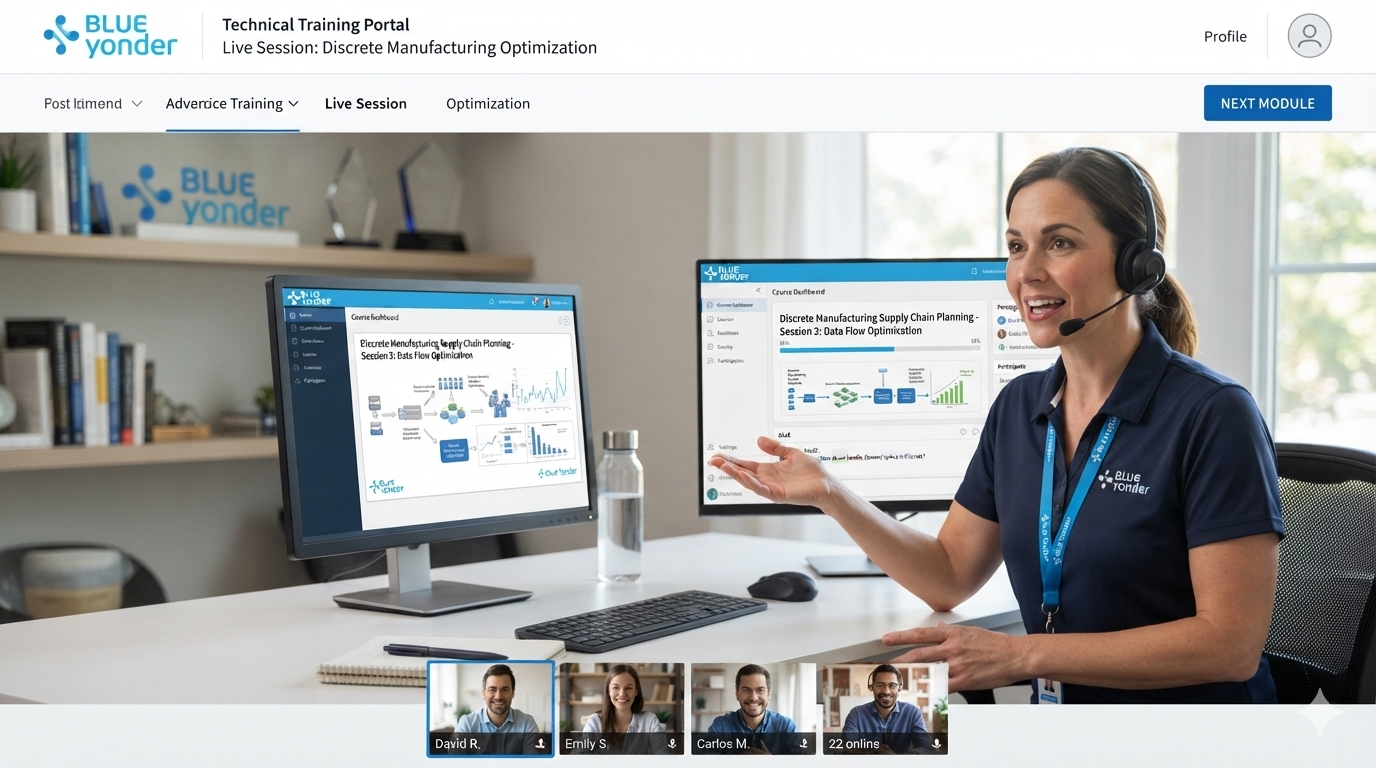
Blue Yonder Discrete Technical Training
Build your technical understanding of Blue Yonder Discrete with structured, expert-led training from TechMunus. Our Blue Yonder Discrete Technical Training program is designed for professionals who want to understand relevant technical concepts, system configurations, application workflows, integration considerations, and troubleshooting approaches within their supply chain technology environment.
Whether you are beginning your learning journey, strengthening your existing technical knowledge, or preparing to participate in an enterprise implementation, the training can be aligned with your experience, learning objectives, and project requirements.
TechMunus offers flexible learning options, including online training, instructor-led sessions, and customized corporate training for individuals and teams across international locations. The program emphasizes practical understanding, guided learning, and scenarios relevant to professional environments.
What Is Blue Yonder Discrete Technical Training?
Blue Yonder Discrete Technical Training focuses on developing technical knowledge related to the relevant Blue Yonder Discrete application, its architecture, configuration approach, system workflows, and integration environment.
In supply chain and manufacturing environments, discrete processes can involve individual products, components, orders, production activities, and associated planning or execution workflows. Understanding the technical side of these systems helps professionals collaborate more effectively with functional teams, developers, implementation consultants, and support specialists.
The exact technical scope depends on the Blue Yonder product, application version, available environment, and project requirements. During training planning, TechMunus can help define the relevant topics and learning objectives so the program aligns with the participant's actual responsibilities.
Why Choose Blue Yonder Discrete Technical Training?
Organizations rely on connected enterprise applications to support operational visibility, efficient workflows, and informed decision-making. Professionals working with these environments need more than a basic understanding of application features; they also benefit from knowing how technical components interact and how to approach common implementation and support challenges.
Blue Yonder Discrete Technical Training can help learners:
- Understand relevant technical concepts and application components.
- Develop familiarity with configuration and system workflows.
- Explore integration concepts and data exchange considerations.
- Improve their approach to technical investigation and troubleshooting.
- Understand how technical activities support implementation projects.
- Collaborate more effectively with functional consultants, business users, and technical teams.
- Prepare for project responsibilities involving system maintenance, enhancements, or support.
The training is intended to connect technical learning with workplace requirements. Topics can be adjusted to suit beginners, experienced professionals, project teams, or organizations seeking targeted technical enablement.
Blue Yonder Discrete Technical Training Modules
The following modules provide a proposed learning structure. The final syllabus should be confirmed against the exact Blue Yonder Discrete product, version, technical documentation, and environment available for training.
Module 1: Introduction to Blue Yonder Discrete
- Overview of the relevant application and its purpose.
- Understanding its role within an enterprise technology landscape.
- Introduction to key technical terminology.
- Overview of common users, system components, and workflows.
- Understanding the relationship between business processes and technical operations.
Module 2: Technical Architecture and System Components
- Introduction to the application's technical architecture.
- Understanding major application components and their responsibilities.
- Overview of system environments and deployment considerations.
- Understanding dependencies between connected components.
- Introduction to access requirements and environment-specific considerations.
Module 3: Application Configuration Fundamentals
- Understanding configuration concepts within the relevant product.
- Reviewing supported configuration options.
- Exploring how configuration relates to business requirements.
- Understanding the importance of controlled changes.
- Reviewing configuration validation and testing approaches.
Practical activities will depend on the product capabilities and access permissions available in the training environment.
Module 4: Data Structures and Application Workflows
- Introduction to relevant data entities and business objects.
- Understanding how data moves through application workflows.
- Reviewing data quality and consistency considerations.
- Exploring common data validation approaches.
- Understanding the impact of incorrect or incomplete data.
Module 5: Integration and Connectivity Concepts
- Understanding integration requirements in enterprise environments.
- Introduction to data exchange and interface concepts.
- Reviewing source and destination system dependencies.
- Understanding interface monitoring and error investigation.
- Exploring integration testing and validation practices.
Specific APIs, interfaces, middleware components, and integration tools will be covered only where applicable to the selected product and training scope.
Module 6: Technical Troubleshooting and Support
- Understanding a structured troubleshooting process.
- Identifying symptoms, possible causes, and dependencies.
- Reviewing application logs and available diagnostic information.
- Investigating configuration and data-related issues.
- Understanding escalation procedures and technical documentation.
- Applying systematic problem-solving methods to representative scenarios.
Module 7: Testing, Validation, and Change Management
- Understanding functional and technical testing responsibilities.
- Reviewing test scenarios and expected outcomes.
- Exploring regression testing considerations.
- Understanding change documentation and approval processes.
- Reviewing deployment readiness and validation practices.
- Recognizing the importance of controlled changes in production environments.
Module 8: Implementation Scenarios and Project Readiness
- Understanding technical activities within an implementation lifecycle.
- Reviewing environment preparation and dependency checks.
- Exploring configuration and integration validation scenarios.
- Understanding the relationship between technical and functional teams.
- Reviewing documentation, handover, and support considerations.
- Applying learned concepts to project-oriented exercises where the environment permits.
Module 9: Revision and Practical Knowledge Assessment
- Review of key technical concepts.
- Guided discussion of common implementation challenges.
- Scenario-based exercises where appropriate.
- Identification of knowledge gaps and areas for further learning.
- Recommendations for continued technical development.
Blue Yonder Discrete Online Training
TechMunus provides an online learning option for professionals who need flexibility while balancing work, project commitments, and other responsibilities.
Online training can be organized around an agreed schedule and delivered through remote sessions. Depending on the program, learners may receive guided explanations, demonstrations, practical discussions, and exercises aligned with the agreed syllabus.
Online training is suitable for professionals in the USA, Saudi Arabia, UAE, UK, Australia, Singapore, Canada, Germany, the Netherlands, and Qatar. Session timings can be discussed according to trainer availability and the participant's time zone.
Online training highlights:
- Remote access to scheduled learning sessions.
- Flexible scheduling by mutual agreement.
- Guided technical explanations and discussions.
- Learning objectives aligned with professional requirements.
- Opportunities to clarify concepts and review relevant scenarios.
Contact TechMunus to discuss the suitable format, syllabus, schedule, and availability for your target product.
Instructor-Led Blue Yonder Discrete Training
Instructor-led training provides a structured learning experience with guidance from a trainer familiar with the agreed technical subject matter.
Sessions can be organized to help participants progress from foundational concepts to more advanced topics, depending on their prior knowledge. Learners can discuss technical questions, review relevant workflows, and work through examples that reflect their professional responsibilities.
The instructor-led format can be useful for implementation consultants, technical support professionals, developers, and project team members who benefit from guided explanations and interactive discussions.
Training activities, demonstrations, and practical exercises depend on the selected syllabus, trainer expertise, and access to appropriate software environments.
Blue Yonder Discrete Corporate Training
Organizations implementing, maintaining, or supporting enterprise supply chain applications may require training that reflects their internal workflows, team responsibilities, and project objectives.
TechMunus can discuss customized corporate training for organizations seeking to develop technical knowledge across individual departments or project teams.
Corporate training may be planned around:
- Team experience levels and learning objectives.
- Relevant technical modules and application workflows.
- Project-specific scenarios and implementation priorities.
- Training schedules suited to distributed teams.
- Knowledge gaps identified by technical managers.
- Agreed learning outcomes and post-training recommendations.
Corporate programs can be discussed for teams based in the USA, Middle East, Europe, Asia-Pacific, and other international markets. Delivery format, trainer availability, pricing, and scope are confirmed during the training consultation.
Who Should Take Blue Yonder Discrete Technical Training?
This training may be suitable for:
Technical consultants: Professionals seeking a structured understanding of application components, configuration concepts, integrations, and technical workflows.
Implementation consultants: Team members involved in enterprise implementation activities who want to strengthen their technical knowledge and understand system dependencies.
Application support professionals: Individuals responsible for investigating issues, supporting users, reviewing errors, and coordinating technical resolutions.
Developers and integration specialists: Professionals working with connected applications who need to understand relevant data flows, interfaces, and application dependencies.
Supply chain technology professionals: Individuals looking to broaden their technical understanding of enterprise applications supporting supply chain or manufacturing operations.
Project team members: Professionals participating in deployment, testing, maintenance, or enhancement projects.
Corporate teams: Organizations that want to develop shared technical knowledge across implementation, support, and application management functions.
Beginners may benefit from introductory technical concepts and basic enterprise application knowledge. The recommended starting level will depend on the exact product and intended training outcomes.
Real-World Use Cases
Blue Yonder Discrete Technical Training can be structured around representative scenarios that help learners connect technical concepts with practical workplace responsibilities.
Application Configuration and Validation
Explore how configuration requirements can be documented, reviewed, tested, and validated before changes are introduced into an application environment.
Integration Issue Investigation
Understand a systematic approach to investigating data exchange problems, including checking available logs, validating inputs, reviewing dependencies, and documenting findings.
Data Quality and Workflow Analysis
Review how incomplete or inconsistent data can affect application workflows and explore methods for identifying and validating potential data issues.
Implementation Testing
Understand the importance of test scenarios, expected outcomes, integration checks, and regression testing during an implementation or enhancement project.
Application Support and Maintenance
Develop a structured approach to investigating reported issues, gathering technical evidence, documenting resolutions, and escalating problems when necessary.
These examples are illustrative training scenarios. They do not imply that every capability is available in every Blue Yonder product or that a particular feature is included in the course.
Blue Yonder Discrete Technical Certification and Preparation
Certification requirements depend on the specific Blue Yonder product and the official certification programs available at the time of enrollment. The availability of a dedicated certification for the exact product described as Blue Yonder Discrete Technical must be verified before making an exam plan.
TechMunus can discuss certification-oriented learning support where an applicable official credential and its requirements can be confirmed. Preparation may include:
- Reviewing the relevant official certification objectives.
- Identifying technical concepts that require additional study.
- Organizing a topic-by-topic revision plan.
- Discussing practice scenarios relevant to the syllabus.
- Reviewing knowledge gaps and recommending further preparation.
- Helping learners plan their next steps toward an applicable credential.
Training completion and official certification are separate. Completing a training course does not automatically award a vendor certification, guarantee exam eligibility, or ensure a passing result. Exam registration, fees, prerequisites, and assessment requirements must be confirmed through the relevant official certification provider.
About the Trainer
Blue Yonder Discrete Technical Training should be delivered by a trainer whose experience matches the selected product, technical scope, and participant objectives.
Before enrollment, TechMunus can discuss the trainer's relevant application knowledge, implementation exposure, technical subject expertise, and experience supporting professional learning. Trainer allocation should be confirmed against the final syllabus rather than assumed from the course title alone.
Participants and corporate training coordinators can request information about the assigned trainer's relevant experience and the proposed training approach before confirming the program.
Why Choose TechMunus?
TechMunus focuses on training programs designed around professional learning objectives and practical business requirements.
When discussing Blue Yonder Discrete Technical Training, learners and organizations can explore:
- Online and instructor-led learning options.
- Individual and corporate training arrangements.
- Syllabus discussions based on technical objectives.
- Flexible scheduling subject to availability.
- Guided learning and relevant technical examples.
- Training recommendations aligned with existing knowledge and project needs.
The final course scope, delivery format, trainer allocation, and practical components will be confirmed before enrollment. This helps learners understand what the program covers and whether it matches their intended outcomes.
Start Your Blue Yonder Discrete Technical Learning Journey
Develop a clearer understanding of relevant Blue Yonder Discrete technical concepts and explore how structured learning can support your professional development or enterprise project.
Whether you are an individual learner, an implementation professional, or a corporate training coordinator, TechMunus can discuss a suitable learning plan based on your goals.
Interested in Blue Yonder Discrete Technical Training?
Contact TechMunus to discuss the course syllabus, online or instructor-led delivery, corporate training requirements, schedule, trainer availability, and applicable certification preparation options.
Request Training Information and take the next step toward building relevant technical knowledge.