
manhattan order management course
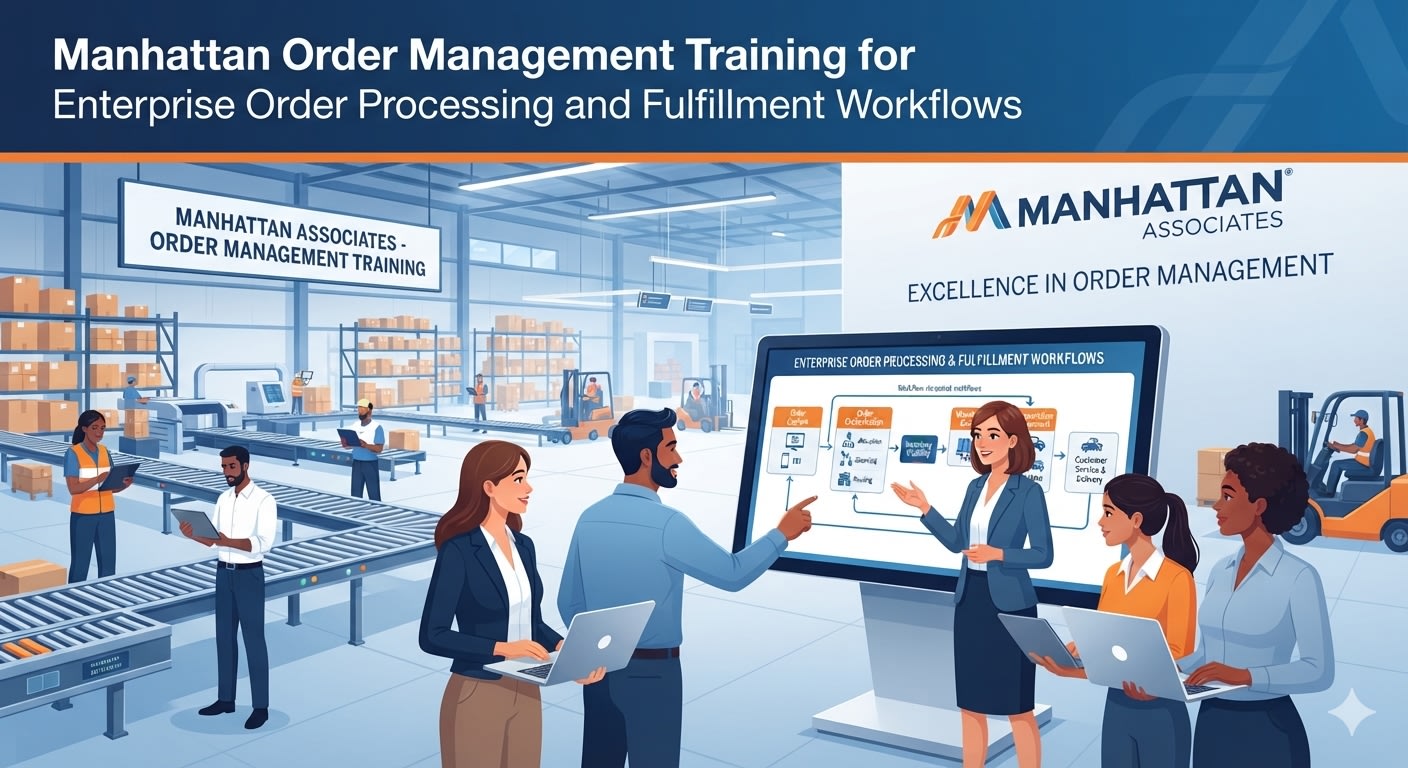
Manhattan Order Management Course Training
Learn how enterprise order management works with our Manhattan Order Management Course Training, designed for professionals who want to understand order processing, fulfillment coordination, inventory visibility, and order lifecycle management in modern retail and supply chain environments.
This training program introduces the key concepts and workflows associated with Manhattan Order Management System (OMS). It is suitable for beginners exploring order management technology, experienced supply chain professionals expanding their technical knowledge, and IT teams preparing for Manhattan OMS-related projects.
Choose online training, instructor-led sessions, or customized corporate training according to your learning objectives, current experience, and project requirements. The course can cover functional concepts, business scenarios, implementation workflows, and practical exercises, depending on the agreed training scope and available training environment.
Build practical knowledge of Manhattan Order Management and understand how order management supports connected commerce and fulfillment operations.
Online Manhattan OMS Training
Learn remotely with a schedule agreed upon before enrollment.
Instructor-Led Learning
Discuss concepts, workflows, and business scenarios with a trainer.
Corporate Training
Align learning objectives with team skills and project requirements.
Ready to explore the course? Contact our training team to discuss your experience, preferred schedule, and learning goals.
What Is Manhattan Order Management?
Manhattan Order Management System is an enterprise technology solution used to coordinate order-related activities across connected commerce and fulfillment operations. An order management system helps businesses manage orders from initial capture through fulfillment, shipment, and completion, depending on the implemented solution and integrations.
Organizations may use order management capabilities to improve order visibility, coordinate inventory availability, support multiple fulfillment locations, and manage exceptions throughout the order lifecycle.
The Manhattan Order Management course introduces learners to these business concepts and explains how order management processes interact with inventory, warehouse operations, payment systems, transportation providers, and customer-facing channels.
Rather than focusing only on terminology, the training connects functional concepts to realistic business scenarios. Learners explore how an order moves through a system, why fulfillment decisions matter, and how teams investigate common order-processing issues.
Manhattan Order Management Course Curriculum
The course curriculum can be tailored to your existing knowledge, project role, and access to training systems. The following modules provide a structured learning path.
Module 1: Introduction to Manhattan Order Management
- Overview of order management systems and their business purpose.
- Order lifecycle stages and common order statuses.
- Introduction to enterprise commerce and fulfillment architecture.
- Understanding the roles of business users, functional consultants, developers, and implementation teams.
Module 2: Order Capture and Order Lifecycle
- Understanding order creation and order submission.
- Reviewing order details, line items, quantities, and customer information.
- Order validation concepts and processing dependencies.
- Order status changes and lifecycle monitoring.
- Exploring cancellations, amendments, and order exceptions where supported by the implementation.
Module 3: Inventory Visibility and Availability
- Introduction to inventory availability concepts.
- Understanding available-to-promise and fulfillment availability.
- Inventory visibility across multiple locations.
- The relationship between inventory information and order acceptance.
- Common inventory-related order issues and their investigation.
Module 4: Order Sourcing and Fulfillment
- Introduction to fulfillment sourcing concepts.
- Understanding how fulfillment locations can be selected.
- Exploring ship-from-store, warehouse fulfillment, and other applicable fulfillment models.
- Split shipments and multi-location fulfillment scenarios.
- Understanding how business rules influence fulfillment decisions.
Module 5: Payments, Shipping, and Integrations
- Overview of payment-related order processing.
- Introduction to shipping, shipment confirmation, and tracking updates.
- Integration concepts involving commerce platforms, warehouse systems, and external services.
- Understanding data exchange and event-driven workflows where applicable.
- Identifying common integration failures and escalation points.
Module 6: Exceptions, Cancellations, and Returns
- Identifying delayed, stuck, or unfulfilled orders.
- Understanding cancellation and amendment workflows.
- Introduction to return and refund coordination.
- Exception investigation and resolution approaches.
- Communicating issues between business, support, and technical teams.
Module 7: Implementation and Configuration Concepts
- Introduction to requirements gathering and process mapping.
- Understanding business rules and configuration dependencies.
- Overview of functional specifications and integration requirements.
- Test scenarios, defect reporting, and user acceptance testing.
- Deployment readiness, support handover, and implementation documentation.
Module 8: Practical Scenarios and Course Review
- Review of end-to-end order processing.
- Scenario-based discussions around inventory and fulfillment.
- Troubleshooting exercises based on representative business situations.
- Functional documentation and process explanation.
- Knowledge review and guidance for continued learning.
Note: Module depth, hands-on exercises, product version, and access to a live or sandbox environment should be confirmed before enrollment. Product-specific features depend on the Manhattan solution and implementation being studied.
Online Manhattan Order Management Training
Our online Manhattan Order Management training is designed for learners who want to develop relevant skills without traveling to a training center. Remote sessions can be arranged for working professionals, career changers, consultants, and distributed project teams.
Training delivery may include live virtual sessions, instructor explanations, demonstrations where an environment is available, practical examples, and question-and-answer discussions. Session timings and the level of practical work should be agreed upon before the course begins.
The program can accommodate learners in the USA, UK, Canada, Australia, Germany, the Netherlands, Singapore, the UAE, Saudi Arabia, Qatar, and other locations, subject to trainer availability and mutually agreed time zones.
If you work full-time, discuss weekday, weekend, or other suitable scheduling options with the training team. International participants should confirm session times in their local time zone before enrollment.
Instructor-Led Manhattan OMS Course
Instructor-led training offers an opportunity to discuss order management concepts with a trainer and explore how workflows relate to actual business requirements.
Depending on the agreed curriculum, sessions can cover functional explanations, process diagrams, scenario walkthroughs, implementation concepts, and troubleshooting discussions. Learners can ask questions about their role, project responsibilities, and areas requiring additional practice.
This format is suitable for people who prefer structured learning and guided explanations instead of relying exclusively on self-study.
Before joining, confirm the trainer's relevant experience, course agenda, session duration, practical components, and any prerequisites.
Manhattan Order Management Corporate Training
Organizations implementing, supporting, or extending order management capabilities may benefit from training aligned with their team's responsibilities.
Corporate Manhattan Order Management training can be customized for functional consultants, business analysts, developers, QA professionals, application support teams, and supply chain stakeholders.
Possible focus areas include:
- Order lifecycle and fulfillment process understanding.
- Functional requirements and business process mapping.
- Order management integration concepts.
- Testing scenarios, defect analysis, and UAT preparation.
- Production support concepts and exception investigation.
- Role-specific learning plans for project teams.
Training can be discussed for teams in North America, Europe, the Middle East, Asia-Pacific, and other regions. Scope, delivery format, group size, timelines, and commercial terms should be confirmed individually.
Planning team training? Share your team's current skill level, project objectives, preferred time zone, and expected number of participants to request a tailored training proposal.
Who Should Take This Course?
The Manhattan Order Management course may be suitable for:
- Beginners: Learners exploring enterprise order management and supply chain technology.
- Business analysts: Professionals working with order processing, requirements, and process documentation.
- Functional consultants: Consultants who want to strengthen their understanding of OMS workflows.
- Developers and integration professionals: Technical teams working with order-related interfaces and system integrations.
- QA and testing professionals: Testers preparing order lifecycle, fulfillment, and exception scenarios.
- Application support professionals: Teams investigating order-processing problems and coordinating resolutions.
- Supply chain and retail professionals: Business users seeking a better understanding of connected fulfillment operations.
- Corporate project teams: Organizations building internal capability for an OMS implementation or support engagement.
Prior experience with Manhattan products, order management, retail, or supply chain processes may be helpful for advanced topics. Beginners can discuss their background with the training team to identify an appropriate learning path.
Real-World Manhattan Order Management Use Cases
Understanding real business situations helps learners connect technical concepts with operational requirements. The course can use illustrative scenarios such as the following.
1. Managing Orders Across Multiple Channels
A retailer receives orders through its website, mobile application, and other sales channels. Learners examine how order information is captured, tracked, and coordinated across the order lifecycle.
2. Selecting an Appropriate Fulfillment Location
An order may be eligible for fulfillment from more than one location. Learners discuss inventory availability, fulfillment constraints, and business rules that can influence sourcing decisions.
3. Investigating Delayed Orders
An order has been accepted but has not progressed as expected. Learners explore possible dependencies, status information, integration issues, and escalation steps that could help identify the problem.
4. Coordinating Shipments and Returns
A customer receives an order in multiple shipments or requests a return. Learners examine how shipment updates, order records, and related business processes may interact.
5. Supporting an OMS Implementation
A project team is preparing for testing and deployment. Learners explore requirements documentation, scenario design, defect reporting, and communication between functional and technical teams.
These scenarios are educational examples, not promises of specific system functionality. Actual workflows vary by product version, configuration, integrations, and business requirements.
Manhattan Order Management Certification and Preparation
Learners often search for Manhattan Order Management certification to validate their knowledge and improve their professional development plans.
It is important to distinguish between course completion, training-provider certificates, and official vendor certification. Completing a training program does not automatically mean that a learner has earned a Manhattan Associates certification.
The course can include certification-oriented preparation through concept reviews, terminology practice, workflow discussions, scenario-based questions, and revision sessions. Any official certification availability, eligibility criteria, exam requirements, and registration process should be verified directly with Manhattan Associates or its authorized certification resources.
Before enrolling, ask the training provider whether the course includes a completion certificate, exam-preparation support, or a verified pathway to a particular vendor credential. Do not assume that any of these are included unless they are explicitly confirmed.
About the Trainer
Effective enterprise technology training requires both subject understanding and the ability to explain concepts clearly.
Our training team can discuss the instructor's relevant experience, areas of specialization, delivery approach, and familiarity with Manhattan Order Management workflows before enrollment.
Trainer profiles should provide verifiable details, such as professional background, relevant project experience, technologies covered, and teaching experience. Where appropriate, include a professional biography, relevant credentials, and genuine learner feedback.
To help learners make an informed decision, request details about the trainer's practical exposure, the product version covered, the course agenda, and the availability of hands-on demonstrations.
Website publishing note: Add the actual trainer's name and verified experience before publishing this section. Do not publish invented qualifications, client names, or certifications.
Why Choose Our Manhattan Order Management Training?
Choose a training plan that reflects your professional goals rather than relying on broad promises.
- Structured curriculum: Learn foundational concepts before progressing to implementation and troubleshooting topics.
- Flexible delivery: Discuss online, instructor-led, or corporate training options.
- Practical learning focus: Explore representative order management and fulfillment scenarios.
- Role-based guidance: Align course depth with functional, technical, testing, or support responsibilities.
- International scheduling: Discuss suitable time zones for your location and working hours.
- Transparent course details: Confirm curriculum, trainer background, delivery format, fees, and certification scope before enrollment.
The objective is to help learners build a clearer understanding of order management processes and develop knowledge relevant to their professional responsibilities.
Enroll in Manhattan Order Management Course Training
Ready to build your understanding of Manhattan OMS? Contact our training team to discuss your learning goals and select an appropriate course format.
Whether you are an individual learner, a working professional, a consultant, or an organization planning team training, we can discuss the relevant modules, delivery schedule, prerequisites, and training scope.
When making an inquiry, include your current role, previous experience, preferred training format, location or time zone, and primary learning objective. This information helps the team assess a suitable training plan.
Request course details today and take the next step toward developing your Manhattan Order Management knowledge.
3. Frequently asked questions (FAQ)
1. What is Manhattan Order Management training?
Manhattan Order Management training introduces the concepts and workflows used to coordinate order processing, inventory availability, fulfillment, shipping, and order exceptions. Course depth depends on the selected curriculum and training environment.
2. Is Manhattan Order Management training available online?
Online training can be arranged for learners who prefer remote instruction. Confirm the available schedule, delivery format, and time zone with the training provider before enrolling.
3. Who can enroll in a Manhattan OMS course?
Business analysts, functional consultants, developers, QA professionals, application support teams, supply chain professionals, and beginners interested in enterprise order management can explore the course.
4. Does the course cover implementation?
The curriculum can include implementation concepts such as requirements gathering, process mapping, configuration dependencies, integration requirements, testing, and deployment preparation. The exact coverage should be confirmed in the course agenda.
5. Does completing the course provide official Manhattan certification?
Not automatically. A training completion certificate is different from an official vendor certification. Verify the relevant credential and exam requirements directly with Manhattan Associates.
6. Is prior experience required?
Foundational modules may be suitable for beginners. Familiarity with retail, supply chain processes, order management, or enterprise applications can be helpful for advanced implementation and technical topics.
7. Is corporate Manhattan Order Management training available?
Corporate training can be discussed for teams that need role-based learning, implementation preparation, testing knowledge, or application support skills. The curriculum and delivery arrangements depend on the organization's requirements.
8. Can international learners join the training?
Learners in the USA, UK, UAE, Saudi Arabia, Canada, Australia, Singapore, Germany, the Netherlands, Qatar, and other countries can inquire about online training. Availability, fees, and schedules should be confirmed with the provider.
9. How long does the Manhattan Order Management course take?
Duration depends on the learner's experience, course depth, practical requirements, and training schedule. Request the proposed module-wise schedule before enrollment.
10. What should I check before enrolling?
Review the syllabus, trainer credentials, practical environment, delivery method, fees, schedule, and certificate details. If you need implementation training, confirm that the proposed curriculum addresses your specific role and project requirements.
12. How do I enrol in Manhattan WMi Training?
Contact Techmunus Submit a training enquiry with your experience level, country, preferred format and objectives. The training team can then discuss the syllabus, schedule, fees and enrolment process.